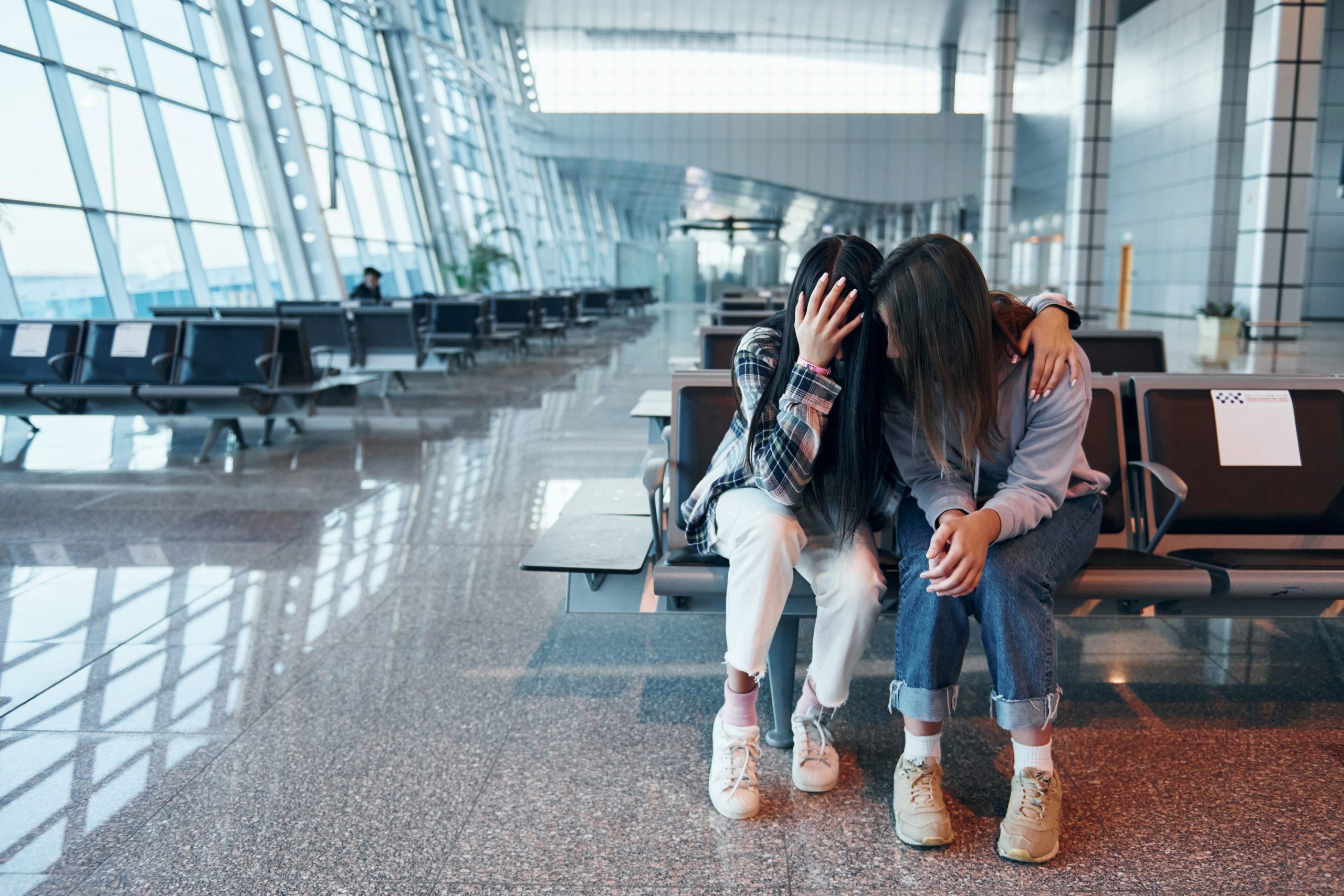
Let’s start with something that rarely gets said out loud: airports are genuinely stressful places — even for people who travel all the time.
The noise is relentless. The signage can feel confusing when you’re rushed. Someone is always sprinting past you pulling a wheelie bag. There’s a queue forming for something you don’t understand yet. You’re not sure if you have time for a coffee, so you buy one anyway, then spend the next ten minutes checking the departure board while it goes cold.
Now imagine all of that through the lens of airport anxiety or fear of flying. The same environment that feels mildly chaotic to a frequent traveler can feel genuinely overwhelming to someone whose nervous system treats every unexpected announcement as a potential emergency. That’s not weakness — that’s a very human response to a very unusual environment.
This guide isn’t about eliminating your anxiety (that’s not really how anxiety works). It’s about understanding what’s actually happening, why airports specifically can be so triggering, and — most importantly — what practical steps, habits, and support can make the experience manageable. Maybe even, in time, something close to enjoyable.
Fear of Flying vs. Airport Anxiety: They’re Not the Same Thing
Most articles bundle these two together, but the distinction actually matters for how you prepare.
Fear of flying (aviophobia) is specifically about being on the aircraft. The loss of control, the altitude, the turbulence, the sounds you can’t explain. It affects a significant portion of passengers to some degree, with many experiencing it severely enough to affect travel decisions. Some people manage it entirely on the ground and only struggle once they’re seated. Others find that the anticipation — the days before a flight — is the worst part.
Airport anxiety is different. It’s the stress that comes from the environment of the airport itself: the crowds, the complexity, the time pressure, the noise, the sheer number of decisions that need to be made correctly in sequence. Many people with airport anxiety are actually fine once they’re on the plane. The hard part is getting through the terminal.
Both are real. Both are more common than you probably think. And — crucially — both are highly responsive to preparation and support. You’re not stuck with this experience.
Why Airports Are Particularly Good at Triggering Anxiety
The sheer scale and complexity of airports can lead to a feeling of mild cognitive overload. Understanding why can take away some of the shame around finding them hard.
Time pressure with no margin for error. Airports are places where missing a deadline can disrupt long-awaited plans, making the experience feel high-stakes. Your brain knows this, and it treats the entire experience as high-stakes from the moment you arrive. Every queue becomes a potential missed flight. Every delay in baggage drop feels like a threat.
Complex, unfamiliar environments. Even if you’ve flown before, each airport is different. Terminals that seem disconnected from each other. Signage that assumes you already know where you’re going. Multiple competing queues at security with no clear indication of which to join.
Loss of control. This is the core of most aviation anxiety, but it extends to the ground too. You can’t make the security line move faster. You can’t control delays. You can’t control turbulence. For people who manage anxiety by staying in control of their environment, airports are a sustained exercise in surrendering that control.
Sensory overload. Constant background noise. Announcements in multiple languages. Crowds moving in all directions. Bright lighting that doesn’t change between 6am and midnight. No natural light in many terminals. No quiet.
The stakes feel high. Travel often coincides with significant life events — holidays that have been planned and anticipated for months, business trips with real consequences, family visits. The emotional weight attached to the journey amplifies every stressor along the way.
What Helps Before You Even Reach the Airport
The single most effective thing for airport anxiety is preparation — not obsessive over-preparation that fuels more anxiety, but calm, practical planning that removes specific unknowns.
Know exactly where you’re going. Look up your terminal in advance. Check whether you need to transfer between terminals. Know which entrance to use. For larger hubs like Heathrow or Frankfurt, this information is on the airport’s website and takes five minutes to confirm. That five minutes can dissolve a significant source of background dread.
Arrive earlier than you think you need to. The anxiety of “do I have enough time” is far more exhausting than spending an extra 30-40 minutes sitting in the departure lounge. Build in enough buffer that even if something goes wrong, you’re fine. Time pressure is the amplifier for almost every other airport stressor.
Do your check-in and admin the night before. Checking in online, saving your boarding pass to your phone, and double-checking your documents in the calm of home rather than at the airport removes an entire layer of uncertainty. One fewer queue. One fewer potential problem.
Tell someone who works at the airport that you’re anxious. This one feels counterintuitive but it’s genuinely useful. Check-in staff and security officers deal with anxious passengers every day. A quiet word — “I get quite anxious in airports, is there anything that would help?” — is more likely to result in patience and small acts of kindness than any other approach. You don’t need to justify it.
Inside the Terminal: Practical Strategies That Actually Work
Identify your anxiety triggers specifically. Security is the most common one — the combination of undressing, the unpredictability of what will trigger the scanner, and the feeling of being watched and judged. Knowing this in advance lets you prepare: keep your bag organised so you can unpack quickly, wear shoes that are easy to remove, and remind yourself that the active part of the process is brief and then it’s done.
Find a physical anchor point. Once through security, many anxious travelers find significant relief in simply sitting down and staying put. Pick a gate, find a seat, and let the environment become familiar. You don’t need to explore. You don’t need to shop. You don’t need to be doing anything. Allowing yourself to just exist quietly in the space for 20-30 minutes often reduces the sensory intensity significantly.
Give your brain something boring to do. Anxiety thrives in mental vacuums. A podcast, a download of a TV show, a book, a long playlist — anything that occupies the default-mode network without demanding too much. The goal isn’t distraction exactly; it’s gentle engagement that keeps your mind from rehearsing worst-case scenarios.
Breathe more slowly than feels natural. This sounds almost offensively simple, but the physiology is real. Anxiety accelerates breathing, which shifts the CO₂ balance in your blood, which makes the physical symptoms of anxiety worse — the racing heart, the light-headedness, the sense of unreality. Deliberately slowing your exhale (longer out than in) signals to your body that you are safe and helps calm the physical symptoms. It doesn’t require any training. You can do it in a security queue.
Avoid excessive caffeine. Coffee and anxiety share a physiological mechanism — elevated cortisol, increased heart rate, heightened alertness. On a calm day this feels like energy. In an airport on a nervous day, it can tip manageable anxiety into something much harder to handle. Tea, water, or decaf won’t make the flight better, but they won’t add fuel to the fire.
The Fear of Flying Itself: What to Know Before You Board
For those whose anxiety is specifically about the flight — not just the airport — a few things are worth knowing.
Turbulence is uncomfortable, not dangerous. Pilots are well aware that this is hard to believe when you’re being bumped around at 35,000 feet. But turbulence is essentially rough air — the aircraft is designed to flex, not to break. Modern commercial aircraft are certified to handle far greater stress than any turbulence you’re likely to encounter. What feels violent from inside often looks unremarkable from the cockpit.
The sounds are mostly normal. The clunk after takeoff (landing gear retracting). The change in engine pitch during descent. The various thuds and hisses that happen throughout a flight. For anxious passengers, each of these can trigger a spike of alarm. If you’ve ever been curious about what a sound actually means, asking a flight attendant before takeoff — “is there anything I should know about the sounds during the flight?” — is a completely reasonable question that most crews are happy to answer.
The statistics are genuinely reassuring if you let them be. Flying is statistically the safest form of long-distance transport. By a significant margin. The challenge is that our brains don’t process statistics well when fear is present — but the information is there if you want to return to it in calmer moments.
Telling the crew helps. Just as at the airport, informing a flight attendant that you’re a nervous flyer often results in small attentions that make a real difference — being told in advance about likely turbulence, a check-in during the flight, an extra few seconds of reassurance before takeoff. Crews genuinely prefer to know.
When Anxiety Is Severe: Professional Options Worth Knowing About
For some people, airport anxiety or fear of flying significantly limits their life — they’re avoiding travel entirely, turning down opportunities, or finding that standard coping mechanisms aren’t always enough. This is worth naming without judgment: it’s very common, and there are professional support systems available.
Cognitive Behavioural Therapy (CBT) is the most well-supported psychological treatment for both aviophobia and generalised anxiety that includes airports. It works by identifying and gradually changing the thought patterns and behavioural responses that maintain the anxiety — not through willpower, but through structured practice.
Fear of flying courses are offered by several airlines and independent providers. These typically combine psychological education with a short supervised flight. Many participants find them genuinely transformative.
Medication — prescribed by a healthcare professional — can be appropriate for some people in specific situations. If you’re considering this, talk to your GP well in advance of travel rather than trying to obtain something the week before.
None of these are necessary for mild to moderate airport anxiety. But if the anxiety is significantly affecting your life, they’re worth knowing exist.
How Airport Assistance Services Help Anxious Travelers
Here’s something that many anxious travelers don’t know: you don’t have to navigate the airport alone.
Meet & Greet and Meet & Assist services were originally designed for business travelers and VIP passengers. But they’ve become increasingly popular among people who simply find airports stressful — because having a dedicated, knowledgeable person by your side transforms almost every element that drives airport anxiety.
Think through the specific triggers: the complexity of unfamiliar layouts, the uncertainty about queues and procedures, the time pressure, the loss of control. A professional greeter helps mitigate these specific triggers. They know the airport. They know which queue is fastest right now. They know where you’re going and have a clear, realistic estimate of how long it will take. You don’t need to make decisions — you just follow someone who knows the answer.
For arrivals, an Aerogreet arrival service means a greeter is waiting for you the moment you step off the aircraft. Immigration, baggage claim, the chaotic arrivals hall — you’re not figuring any of it out alone.
For departures, a departure service means your greeter meets you at the entrance and guides you through check-in, security, and all the way to your gate — often with access to fast track lanes that bypass the longest queues entirely. The time pressure that drives so much airport anxiety is significantly reduced when you have someone who knows exactly how much time you have and exactly how to use it.
For connections, a transit service is perhaps where this help is most valuable. Tight connections at unfamiliar airports are one of the most anxiety-provoking situations in travel. A transfer assistant meets you at the gate as you land and gets you to your next departure — no running through corridors wondering if you’ve gone the wrong way, no standing at a departures board frantically reading gate numbers.
This kind of service isn’t just for VIPs or business travelers. It’s for anyone who wants to take the airport out of the hard category.
A Note on Travelling with Someone Who Has Anxiety
If you’re reading this on behalf of a partner, parent, child, or friend — the most useful thing you can do is resist the urge to minimise.
“It’ll be fine” is offered with the best intentions but is rarely reassuring to someone whose nervous system is already convinced that it won’t be. More useful: “I’m going to stay with you the whole time” and “Tell me what the hardest bit is and let’s figure that out together.”
Practical gestures beat reassurance. Take the bags. Navigate the signage. Make the decisions where you can. And build in more time than you think you need — the gift of not being rushed is genuinely transformative for an anxious travel companion.
The Airport Isn’t the Enemy
Airports can be overwhelming due to their sheer scale — they process millions of people and enormous logistical complexity simultaneously. Finding them hard isn’t a personal failure. It’s a reasonable response to an unusual environment.
The goal isn’t to become someone who finds airports easy. The goal is to find an approach — whether that’s preparation, breathing, professional assistance, or a combination — that makes the experience manageable. That’s enough. That’s a flight taken, a trip made, a destination reached.
And the more often you do it with adequate support, the more the unfamiliar becomes familiar. That’s not a promise. But it’s what tends to happen.
Aerogreet provides Meet & Greet, Meet & Assist, and Fast Track services at airports worldwide — including dedicated support for passengers who find travel stressful. See all available airports and services

 Alexander Stepanovskiy