Málaga Airport (AGP): The Complete Traveller’s Guide to Spain’s Sun-Drenched Gateway
Information in this guide is accurate as of April 2026. Operational details — terminal assignments, security layouts, and transport schedules — are subject to change. Always verify the latest information on before you travel.
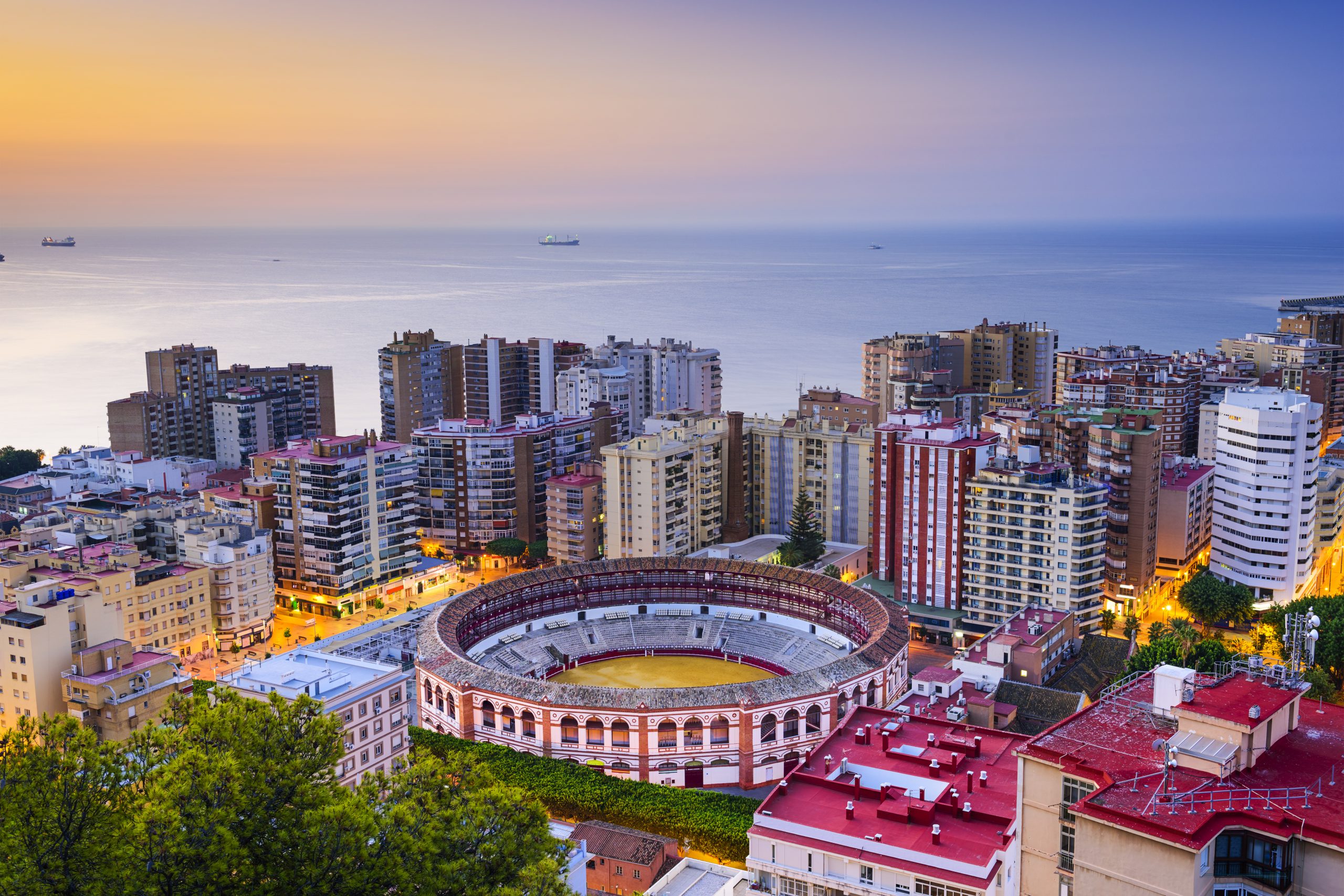
There is something almost cinematic about landing at Málaga. The Mediterranean appears first — a long, flat shimmer cutting across the horizon — then the coastal strip of the Costa del Sol tightens into view, dense with white buildings stacked against brown hills. By the time you touch down at Málaga–Costa del Sol Airport, you already feel like the holiday has begun.
That feeling is no accident. Málaga–Costa del Sol Airport (IATA: AGP, ICAO: LEMG) has been welcoming travellers since 1919, making it one of the oldest airports in Spain still operating from its original site. More than a century later, it handled just under 25 million passengers in 2024 — a record at that time — and closed 2025 with an estimated 26.7 million. It is, comfortably, the fourth busiest airport in Spain and the unrivalled gateway to Andalusia.
This guide covers everything you need to know before you land: the airport’s history, its terminal layout, transport connections, services, and how to make your arrival — or departure — genuinely seamless.
A History That Predates Package Holidays by Decades
The story of Málaga Airport begins on 9 March 1919, when a French aviation entrepreneur named Pierre Latécoère touched down a Salmson 2A biplane on a flat plot of land south-west of the city, known locally as El Rompedizo. Latécoère was not on holiday. He was scouting locations across the Iberian Peninsula for a series of aerodromes to support his vision: a commercial air route connecting France to its African colonies — via Spain, Morocco, and eventually, South America.
His pilot on those early test flights over Málaga was Didier Daurat, a decorated veteran of the First World War who would later become the first director of the Málaga aerodrome. On 1 September 1919, Daurat inaugurated the first regular scheduled service from the site: a route linking Toulouse, Barcelona, Alicante, Málaga, Tangier, and Casablanca. Málaga was, from the very beginning, an international airport.
The following decades were turbulent. In 1937, during the Spanish Civil War, the aerodrome was converted into a military air base, hosting schools for Air Force crew members, observers, and specialists. It remained under military control until 12 July 1946, when it was formally reopened to civil domestic and international traffic. The first dedicated civilian passenger terminal opened two years later, in 1948.
The real transformation came with the tourism boom of the 1960s. The Costa del Sol went from relative obscurity to one of Europe’s most sought-after holiday destinations in the space of a decade, and the airport had to keep pace. A new terminal opened in 1968, followed by a second — a Modular Station for Non-Scheduled Traffic — on 30 June 1972, built specifically to handle the surge in charter flights from across Europe. By the mid-1960s, around thirty airlines were operating non-scheduled services into Málaga. The airport was, already, a leisure hub unlike most others in Spain.
The landmark that most regular travellers today associate with the airport’s identity opened on 30 November 1991: the Pablo Ruiz Picasso Terminal (T2), designed by the celebrated Catalan architect Ricardo Bofill. Picasso was born in Málaga in 1881, and naming the new terminal after the city’s most internationally famous son felt both appropriate and overdue. Bofill’s design — with two distinct floors separating arriving and departing passengers — was a genuine step forward in passenger flow logic.
In 2010, the airport completed its most ambitious expansion to date: Terminal 3, designed by architect Bruce S. Fairbanks, with 250,000 m² of floor space and a capacity of 30 million passengers per year. A second runway followed, officially inaugurated on 26 June 2012. In 2011, the airport received its current official name: Málaga–Costa del Sol Airport, replacing the commonly used but unofficial reference to Picasso’s name.
In early 2024, Aena — the Spanish state-owned operator that manages the airport — began talks about expanding Terminal 3 or constructing an entirely new Terminal 4, given the airport’s continued growth. No formal timeline has been announced as of the time of writing.
What Does “AGP” Actually Stand For?
It’s one of the most frequently asked questions about this airport. The IATA code AGP bears no obvious relation to “Málaga.” The reason is practical: by the time IATA assigned codes to Spanish airports, all the letter combinations beginning with “MAL” had already been allocated elsewhere. The code was instead derived from letters later in the word — specifically “AG” from mÁlaGA. The “P” has generated considerable speculation over the years.
One popular theory links it to the Pablo Ruiz Picasso Terminal — but that terminal didn’t open until 1991, long after the IATA code was assigned. Another story, widely circulated in travel guides, claims the code references a now-defunct nickname: Aeropuerto de la Gaviota Plateada (Silver Seagull Airport), allegedly inspired by the large numbers of silver gulls that frequented the site in the 1960s. This is appealing as an explanation but should be treated as local lore rather than documented fact. IATA has not confirmed it officially.
Understanding the Terminals: Simpler Than It Looks
The airport officially has three passenger terminals — T1, T2, and T3 — plus a General Aviation Terminal for private and executive flights and a separate Cargo Terminal. In practice, the passenger experience is considerably more straightforward than that sounds.
Terminal 1 (T1) is effectively closed under normal operating conditions. Opened in 1972, it is available as overflow during peak congestion but plays no meaningful role in day-to-day passenger operations.
Terminal 2 (T2) — Pablo Ruiz Picasso Terminal is Ricardo Bofill’s design: clean lines, logical floor separation. Departures occupy the upper level, arrivals the ground floor. T2 is internally connected to T3 and, for most passengers, the two terminals feel like a single continuous building. EasyJet flights use T2 for check-in. It is home to Pier B (13 gates, used for non-Schengen traffic) and Pier C (used primarily for non-Schengen, with flexibility for Schengen routes as needed).
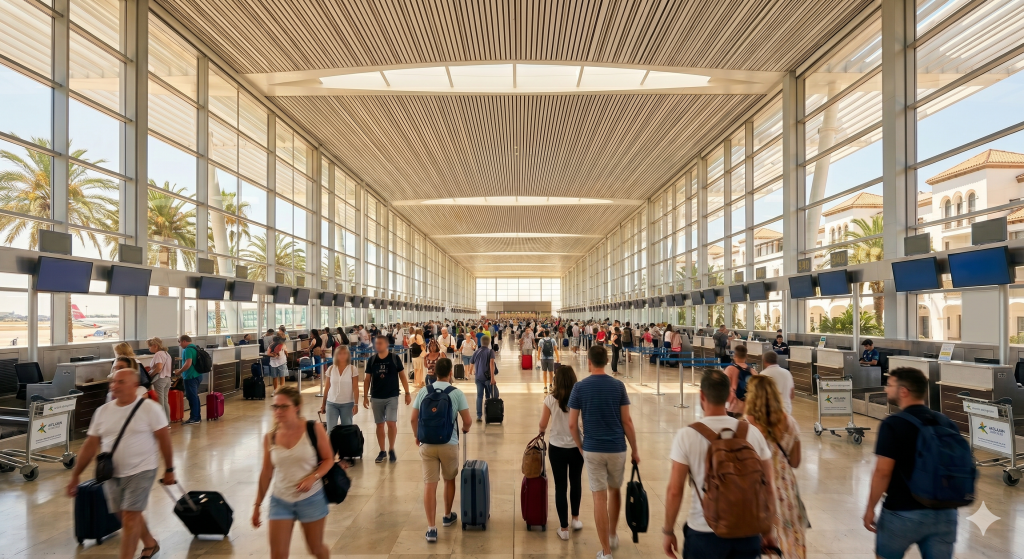
Terminal 3 (T3) is where the overwhelming majority of passengers arrive, check in, and depart. Its vast check-in hall — with numbered counters from 301 to 386 — handles most airlines operating at AGP. Beyond a single, centralised security checkpoint (common to both T2 and T3), passengers enter the airside departure zone, which connects seamlessly to all three piers. The floor plan is intuitive: Departures on the upper level, Arrivals on the ground floor.
The Piers
The airport operates three active piers:
- Pier B — non-Schengen flights; 13 gates, 7 with airbridges
- Pier C — primarily non-Schengen, with Schengen flexibility; 10 gates, 7 with airbridges
- Pier D — Schengen flights; 20 gates, 12 with airbridges
In total, the airport has 164 check-in desks and 48 boarding gates, of which 26 are equipped with airbridges.
A practical note: moving between T2 and T3 on the landside takes only a few minutes on foot. Once through security, all piers are accessible from the shared airside zone. Unlike some multi-terminal European airports, you do not need a shuttle or a separate security pass to move between areas.
Getting There and Getting Away: Transport From AGP
Málaga Airport sits in the district of Churriana, approximately 8 km south-west of Málaga city centre and 5 km north of Torremolinos. Transport options are varied and well-organised.
Cercanías Train (Line C1)
The underground station at the airport connects directly to Málaga María Zambrano (the main intercity rail station) in approximately 12 minutes, and to Málaga Centro-Alameda in around 16 minutes. For travellers heading to resort towns along the coast — Torremolinos, Benalmádena, Fuengirola — the same line continues west along the shore.
Car Rental
All major international rental agencies — Avis, Europcar, Hertz, Sixt — are represented at the airport. For those planning to explore Andalusia independently — the roads to Ronda, Granada, Seville, or the white villages of the interior are among the finest drives in Spain — renting at the airport is a practical option.
Private Transfers
For travellers who value their time and want the journey from airport to destination to feel as considered as the rest of the trip, a private transfer is the cleanest option available. No queues, no negotiating, no uncertainty about price or timing — just a driver waiting for you, vehicle chosen to match your needs, whether that is a saloon for two or a premium SUV for a family with luggage.
Aerogreet arranges private transfers to and from Málaga Airport on request, coordinated alongside your Meet & Assist service for a fully seamless door-to-door experience. If you are arriving at AGP with a meet-and-greet escort and want your vehicle waiting the moment you clear arrivals, that is exactly the kind of detail we handle. Get in touch to arrange your private transfer →
Who Flies Here — and Where From
Málaga Airport is a leisure-dominant hub, with approximately 85% of its traffic classified as international. The UK is the single largest source market by a significant margin: in 2024, British passengers accounted for over 5.69 millionof the airport’s movements. Germany followed with around 1.97 million, the Netherlands with 1.48 million, France with 1.36 million, and Italy with 1.29 million.
Among the fastest-growing markets in 2024 were the Czech Republic (+82.4%) and Poland (+56.4%) — a reflection of the growing appetite for Costa del Sol holidays across Central and Eastern Europe.
Key bases at AGP include Ryanair, EasyJet, Vueling, Air Europa, and Norwegian. The airport connects to over 60 countries and more than 150 cities across Europe, North Africa, the Middle East, and North America.
Inside the Terminals: What to Expect Airside
The airside area of Terminal 3 is spacious and bathed in natural light through high glass facades. Shopping and dining are concentrated in the departure zone after security:
- “The Shop” duty-free occupies a prominent position in the departure area, covering perfumes, spirits, tobacco, and Spanish delicacies.
- Starbucks provides a reliable coffee option before boarding.
- Dehesa Santa María offers Spanish tapas and Iberian charcuterie — a decent last taste of Andalusia before heading home.
- A range of fast-food and casual dining options (including Burger King and the Eat. chain) serve passengers looking for something quick.
Free Wi-Fi is available throughout the terminal, with charging stations at gates and in waiting areas.
For those travelling in premium cabins or holding lounge access, AGP has a dedicated VIP lounge available to business class passengers, Priority Pass holders, and walk-in guests. It provides a noticeably quieter and more comfortable wait than the open departure hall — worth considering during busy summer periods. Lounge access is included as part of our services — see our website for full details.
A lesser-known feature worth mentioning: a National Museum of Airports and Air Transport is located on the airport’s grounds, featuring historical aircraft, a restored control tower, and artefacts charting the story of Spanish aviation. It is a genuinely interesting stop if time permits.
Peak Periods and What to Know Before You Go
Málaga Airport is seasonal in the truest sense. The summer months — July and August — account for the heaviest traffic, as millions of European sun-seekers converge on the Costa del Sol simultaneously. Easter week (Semana Santa) and the May and October shoulder seasons have also grown significantly busier in recent years.
During peak periods, security queues at Terminal 3’s centralised checkpoint can be lengthy. The airport recommends arriving at least 2.5 to 3 hours before non-Schengen and international departures, and 1.5 to 2 hours before Schengen or domestic flights. For travellers who value their time — and who want to spend it on a terrace overlooking the Mediterranean rather than in a queue — getting through the airport as efficiently as possible matters.
A Note on the VIP Experience at AGP
Málaga may project a laid-back, sun-soaked energy, but the airport itself is a high-volume operation, especially in summer. Navigating it efficiently — particularly on arrival, when immigration, baggage reclaim, and ground transport all converge — is something that rewards preparation.
For those who prefer a smoother passage, Aerogreet offers professional Meet & Assist services at Málaga Airport. Whether you are arriving and want a dedicated greeter waiting at the gate to guide you through immigration and to your transfer, departing and want to bypass queues at check-in and security with Fast Track assistance, or transiting and need an escort between connections — the service is designed around your schedule, not the airport’s.
Aerogreet operates 24/7 across 950+ airports worldwide and has served over 42,000 clients. Booking is fully automated and available online.
Málaga Airport is not simply a functional transit point. It carries over a century of aviation history, sits at the crossroads of European leisure travel, and — on a clear morning — offers a view of the Mediterranean before you have even collected your luggage. Understanding how it works makes the difference between a scrambled start to a trip and a genuinely effortless one.
Whether you are arriving for the first time or the
tenth, travelling solo or with family, the airport rewards those who come prepared.
Safe travels.
Key Facts at a Glance
Official Name: Málaga–Costa del Sol Airport
IATA / ICAO:AGP / LEMG
Location: Churriana, 8 km SW of Málaga city centre
Ranking in Spain: 4th (after MAD, BCN, PMI)
Passengers (2024): 24,923,774
Passengers (2025 est.): ~26.7 million
Terminals in use: T2 (Pablo Ruiz Picasso) + T3
Piers: B (non-Schengen) · C (flex) · D (Schengen)
Runways: 2
Check-in desks: 164
Boarding gates: 48 (26 with airbridges)
International traffic share: ~85%
Top source market: United Kingdom — 5.69M passengers (2024)

 Alexander Stepanovskiy