And Why Meet & Assist Is Now More Valuable Than Ever
Quick summary: The EU Entry/Exit System (EES) became fully operational on 10 April 2026 across all 29 Schengen countries. It replaces passport stamps with biometric registration – fingerprints and a facial scan – for all non-EU nationals on short stays. Early rollout data shows border processing times increased by up to 70% at major airports, with queues reaching 2-4 hours on the first day of full deployment. This guide explains exactly how EES works, who it affects, and where professional Meet & Assist makes a measurable difference.
(Looking for a quick, actionable pre-flight checklist? See our EES EU Requirements Guide).
Table of Contents
- What Is the Entry Exit System (EES)?
- When Did EES Start – and What Is the Current Status?
- Who Does EES Apply To?
- What Happens at the Border Under EES?
- The 90/180 Rule: What EES Changes for Overstay Enforcement
- Real-World Impact: Queues, Delays, and Missed Flights
- Which Airports Are Most Affected?
- EES vs ETIAS: Two Separate Systems, One Travel Reality
- Where Meet & Assist Genuinely Helps Under EES
- Who Benefits Most from Meet & Assist in the EES Era?
- How to Book Meet & Assist at Your European Airport
- Frequently Asked Questions About EES
1. What Is the Entry Exit System (EES)?
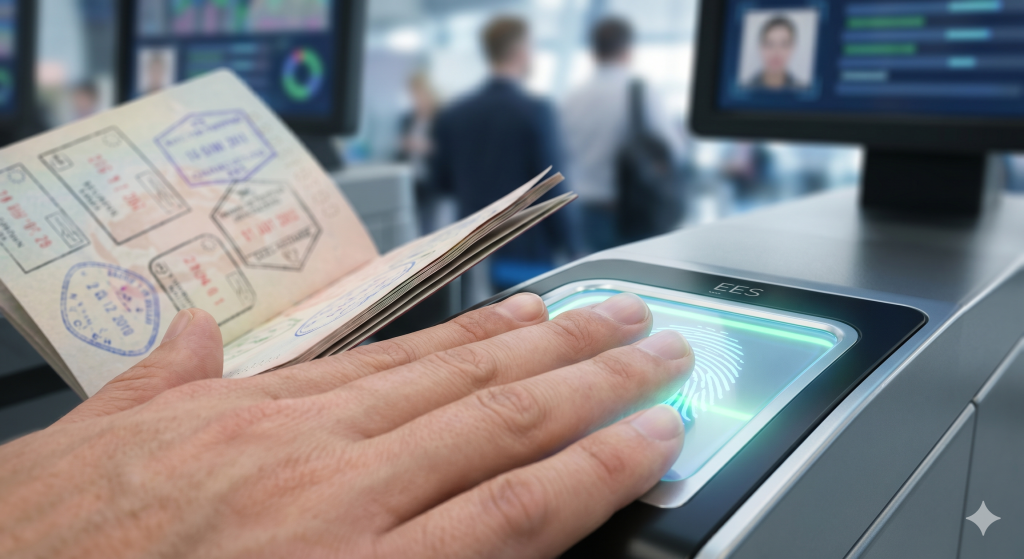
The EU Entry Exit System, commonly abbreviated as EES, is a new automated digital border management system introduced by the European Union. Its core purpose is to replace the physical stamping of passports with a secure, centrally managed electronic record of every non-EU traveller crossing the external Schengen border.
Under EES, each time an eligible traveller enters or exits the Schengen Area, the system records:
- Full name and travel document details
- Biometric data: a facial image and fingerprints (four fingers on the first registration)
- The exact date, time, and location of each border crossing
- Refusals of entry, if applicable
This data is stored in a shared EU-wide database for three years, with the retention period renewing on each border crossing. It is accessible to border authorities in all participating countries.
The EES is a flagship component of the EU’s broader “Smart Borders” initiative, designed to modernise border management, improve security, and reduce identity fraud. According to the European Commission’s official migration and home affairs page, EES also serves as the technical foundation for the forthcoming ETIAS pre-travel authorisation system.
2. When Did EES Start — and What Is the Current Status?
The entry exit system has been years in the making, delayed multiple times since its original 2022 target. Here is the definitive timeline:
12 October 2025: 12 October 2025 EES phased launch begins (approx. 10% of ports)
January 2026: At least 35% of eligible travellers registered
March 2026: All border points operating EES; at least 50% of travellers processed
10 April 2026: Full deployment – 100% of eligible travellers processed at all Schengen external borders
The phased approach was intentional: the EU needed time to roll out kiosks, train border staff, and allow travellers to adjust. However, even during the ramp-up phase, real-world conditions fell short of projections. Portugal suspended EES at Lisbon Airport in December 2025 due to widespread delays; Gran Canaria experienced system crashes; and on the very first day of full deployment (10 April 2026), queues of up to four hours were reported at several Schengen airports.
As of today (April 2026), EES is live and mandatory at all Schengen external border crossing points. Member states retain limited flexibility to partially suspend biometric collection during acute congestion periods, but full suspension options ended on 10 April 2026.
3. Who Does EES Apply To?
EES applies to non-EU nationals travelling for a short stay – defined as visits up to 90 days within any 180-day period — to any of the 29 participating European countries. This includes:
- UK citizens (following Brexit, British passport holders are now third-country nationals)
- US, Canadian, Australian, and New Zealand citizens
- All other non-EU visa-exempt nationalities
- Non-EU nationals holding short-stay Schengen visas
Who is exempt from EES:
- EU citizens and nationals of EEA countries and Switzerland
- Non-EU nationals holding a valid EU long-stay visa or residence permit
- Irish passport holders (Ireland is not part of Schengen)
- British passport holders with EU residency status
- Certain diplomatic and service passport holders
A special rule applies to children: those under 12 years old must undergo a facial scan but are exempt from fingerprint collection.
It is important to note that EES is a Schengen-border system, not an EU-wide one. Cyprus and Ireland are EU member states that do not participate in Schengen and therefore do not apply EES. Bulgaria and Romania apply EES only at air and sea borders.
4. What Happens at the Border Under EES?
The practical border experience has changed significantly. Here is what non-EU travellers now face when entering or exiting the Schengen Area.
First-time EES crossing (initial registration):
This is where the biggest delay occurs. A first-time registrant must:
- Scan their biometric (e-chip) passport at a self-service kiosk or staffed booth
- Have a facial image captured by a camera
- Have fingerprints scanned (four fingers, both hands for some nationalities)
- Answer standard Schengen Border Code questions (purpose of visit, accommodation, means of subsistence)
- Receive confirmation that a digital profile has been created
The European Commission cites an average processing time of 70 seconds per traveller under optimal conditions. In practice, during peak periods, the process has taken considerably longer per person — and the cumulative effect on queue lengths has been severe.
Subsequent EES crossings (returning travellers):
Once registered, returning travellers face a faster process: their passport is scanned, and facial recognition confirms identity against the stored biometric profile. The queue impact is primarily concentrated on first-time registrants, who slow the lines for everyone behind them.
If your passport does not have an electronic chip:
Older passports without an embedded chip cannot use automated kiosks. A border officer must process you manually at a staffed counter. You will still be registered in the EES, but the process takes longer. If you travel to Europe regularly, renewing to a biometric passport before your trip is strongly advisable.
Arriving without biometric data already collected:
Some airports are still deploying kiosks or managing capacity. Where kiosk availability is limited, officers may defer biometric collection (collecting name and passport data only) and require you to provide fingerprints and a facial scan on departure. This inconsistency is one of the key operational challenges flagged by industry bodies including IATA, ACI Europe, and Airlines for Europe.
5. The 90/180 Rule: What EES Changes for Overstay Enforcement
The Schengen 90/180 rule is not new — it has always applied to non-EU travellers on short stays. What is new is how it is enforced.
Previously, border officers relied on physical passport stamps to calculate the number of days spent in the Schengen Area within a rolling 180-day window. Stamps could be illegible, absent, or inconsistently applied. Overstay detection was largely manual and therefore imperfect.
Under EES, every entry and exit is digitally recorded with a precise timestamp and location. The system automatically calculates the number of days a traveller has spent in the Schengen Area and flags anyone who has exceeded their 90-day allowance. This makes overstay detection near-automatic, consistent, and cross-border.
Practical implications:
- Travellers who previously relied on ambiguity in stamp records now face accurate, real-time tracking
- Overstayers are recorded in the system, and refusals of entry will be visible to border authorities in all participating countries on future trips
- Anyone who has been denied entry is stored in the database, triggering alerts at other Schengen borders if they attempt to enter under a different identity
This enforcement upgrade is one reason why professional guidance at the border matters more than it did before. An experienced Meet & Assist agent familiar with local border procedures can ensure travellers are properly directed and avoid unnecessary complications.
6. Real-World Impact: Queues, Delays, and Missed Flights
The gap between projected and actual EES processing times has been one of the defining stories of European travel in early 2026. Here is what the data shows:
- 70% increase in border processing times at major airports during the initial rollout phase, according to Airports Council International (ACI) Europe
- Queues of up to 3 hours recorded at airports in France, Germany, Greece, Iceland, Italy, Portugal, and Spain during the phased rollout
- Queues reaching up to 4 hours reported on 10 April 2026, the first day of full mandatory deployment
- At Brussels Airport, a late-March peak resulted in nearly 600 missed flights in four days
- A software glitch at Brussels in February 2026 disabled all 24 e-gates, causing 90-minute queues
- Portugal suspended EES operations at Lisbon, Porto, and Faro airports on the morning of 11 April 2026 due to excessive wait times before restarting in the afternoon
- At one UK departure, 51 booked passengers missed their flight due to EES-related border delays
Airlines including Ryanair and EasyJet have reported passengers regularly missing departures. Ryanair’s CEO publicly described the EES rollout as a “shambles,” and industry bodies – ACI Europe, Airlines for Europe, and IATA – have written jointly to the EU Commissioner for Internal Affairs demanding emergency flexibility for suspension during peak summer travel.
The Brussels Airport data is particularly stark. The airport advised all non-Schengen passengers to arrive at least 3 hours before departure – a recommendation unprecedented at most modern European airports.
7. Which Airports Are Most Affected?
EES applies at all Schengen external borders, but certain airports have reported more severe disruption due to their passenger volumes, staffing levels, and pace of infrastructure deployment.
Airports most impacted to date include:
- Paris Charles de Gaulle (CDG) – France’s Parafe e-gates were initially incompatible with UK and US passports for EES processing; major international hub with high third-country traffic. See our CDG VIP guide.
- Lisbon Humberto Delgado Airport (LIS) – Suspended EES in December 2025 and again on 11 April 2026 due to excessive queues
- Brussels Airport (BRU) – Reported 3.5-hour peak queues and over 600 missed flights in a single four-day period
- Frankfurt Airport (FRA) – Europe’s fourth-busiest airport and a major UK/US transit hub, with significant third-country national traffic. See our Frankfurt Airport guide.
- Palma de Mallorca (PMI) – A major summer leisure destination, flagged for likely severe disruption during peak season
- London Heathrow (LHR) – Though in the UK (non-Schengen, EES does not apply on entry to the UK), UK passport holders face EES processing on every return from Schengen. See our Heathrow Meet & Greet guide.
- Amsterdam Schiphol (AMS) – A major Schengen hub with 60+ million passengers annually. See our Schiphol VIP guide.
- Madrid Barajas (MAD) – Spain’s largest airport, handling significant non-EU traffic from Latin America, the US, and Asia
If you are travelling through any of these airports, factoring in EES processing time is no longer optional – it is essential travel planning.
8. EES vs ETIAS: Two Separate Systems, One Travel Reality
Travellers frequently confuse EES and ETIAS. They are distinct systems, both part of the EU’s Smart Borders programme, but operating at different stages of the journey.
EES (Entry/Exit System) — NOW LIVE
- Applies at the border, when you arrive or depart
- No pre-registration required before travel
- Collects biometric data and records each crossing
- Fully operational since 10 April 2026
(Need to know exactly what documents to prepare? Check our EES EU step-by-step checklist).
ETIAS (European Travel Information and Authorisation System) — Expected late 2026
- Applies before travel, similar to the US ESTA or UK ETA
- Requires visa-exempt non-EU nationals to apply online and receive authorisation before their trip
- Cannot travel without a valid ETIAS once live
- Countries covered include all Schengen members plus a few additional nations
- The official application portal will be travel-europe.europa.eu/etias once live
The critical point: once ETIAS is live, non-EU visa-exempt travellers will need both a valid ETIAS authorisation before departure and EES registration at the Schengen border. ETIAS is expected to launch approximately six months after full EES implementation — meaning a late 2026 target is realistic, though no fixed date has been confirmed by the Commission as of April 2026.
9. Where Meet & Assist Genuinely Helps Under EES
This is the core question for any non-EU traveller planning a Schengen trip in 2026 and beyond. Does professional airport assistance actually change the EES experience? The honest answer is: yes, in specific and meaningful ways – though it is important to be precise about what it can and cannot do.
What Meet & Assist Cannot Do
Meet & Assist agents cannot bypass EES itself. Every eligible non-EU traveller must register biometric data on their first crossing, and every subsequent crossing must be logged. The EU’s border system is mandatory, and no concierge service provides legal exemption.
What Meet & Assist Can Do – and Does Very Well
- Fast Track access at passport control
The most direct value of Meet & Assist under EES is access to Fast Track immigration lanes. At airports where Fast Track channels are available, professional agents escort clients directly to priority queues, bypassing the general population queues that are now routinely running at 60–240 minutes. This is the single most impactful benefit in the EES era.
At Aerogreet’s Arrival Service, the standard Meet & Assist package includes escort through passport control, with the Meet & Assist + Fast Track tier providing expedited processing through priority immigration channels.
- Navigating an unfamiliar, still-inconsistent system
EES implementation remains uneven. Different airports have different numbers of kiosks. Some have e-gates that work for your passport type; others redirect you to staffed counters. Some have pre-registration stands near check-in; others direct you directly to border control. An on-the-ground agent who works that airport daily knows exactly which lane to use, which kiosk to queue at, and what to do if the system malfunctions – experience that can save 30-60 minutes even outside Fast Track.
- Departure Fast Track – the underappreciated benefit
EES applies on departure too. Travellers exiting the Schengen Area must have their exit recorded in the system. This adds processing time to departure queues that previously moved faster than arrivals. Aerogreet’s Departure Service includes Fast Track escort through security and border control, ensuring clients reach the gate with time to spare even when EES exit queues are building.
- Transit and connection management
Under EES, non-EU travellers transiting through a Schengen hub and exiting at another Schengen airport must have their crossing recorded. This has introduced a new layer of processing complexity for connection passengers — particularly those with tight layovers. Aerogreet’s Transit Service is specifically designed for this scenario: a professional greeter meets you at the gate, guides you through any required border formalities, and escorts you to your connecting departure with the minimum possible delay.
On some itineraries, this escort can be the difference between making or missing a connection.
- Assistance for passengers who need it most
EES kiosks require physical interaction – fingerprint pads, cameras at specific heights, touchscreens in a second language. For elderly travellers, passengers with reduced mobility, families travelling with young children, and anyone unfamiliar with biometric technology, this process can be confusing, stressful, and slow. A professional agent handles the logistics, explains each step, and ensures no one is left stranded in a queue they do not know how to navigate.
- Pre-emptive planning and timing advice
Experienced greeters know peak queue times at their airports. They know when EES kiosks are most congested (typically mid-morning at major hubs). When Aerogreet’s team receives your booking, they factor current airport conditions into their planning – advising on optimal arrival times and anticipating where delays are likely.
10. Who Benefits Most from Meet & Assist in the EES Era?
Not every traveller faces the same EES risk profile. The following groups have the most to gain from professional airport assistance in the current environment.
First-time EES registrants. If this is your first entry into the Schengen Area since October 2025, you face the longest processing step: full biometric capture on first registration. This is where queues are most severe, and where Fast Track access delivers the clearest time saving.
Frequent business travellers. Missing a connection or arriving late to a meeting because of a 90-minute passport queue is now a realistic risk for anyone without Fast Track access. Business travellers who pass through Schengen hubs regularly should treat Meet & Assist as a standard travel expense, not a luxury.
Families with children. EES kiosks were not designed with young children in mind. Facial recognition cameras struggle to capture children’s faces; fingerprint readers are sized for adults; and the sheer logistics of managing luggage, documents, and anxious children while navigating biometric registration is stressful. For families, a dedicated greeter changes the entire experience.
Elderly travellers and passengers with reduced mobility. Priority assistance is both a practical benefit and, in many cases, a legal right. An experienced greeter ensures you are directed to the appropriate lane, supported through each step, and not left waiting in a general queue that may require extended standing.
Passengers with tight connections. The EES adds processing time that was not part of connection planning a year ago. If your layover was calculated based on pre-EES norms, it may no longer be sufficient without Fast Track access.
Passengers travelling on older passports. Non-biometric passports (without embedded chips) cannot use automated EES kiosks, routing you to a staffed counter and typically a longer wait. A greeter can direct you to the correct processing point immediately and ensure you are not routed through queues that cannot actually process your document.
Anxious or infrequent travellers. If the airport environment is already stressful, adding an unfamiliar biometric registration system into the mix makes it harder. A familiar, professional face guiding you through the process has real psychological value — a point our dedicated guide to flying with anxiety explores in depth.
11. How to Book Meet & Assist at Your European Airport
Aerogreet provides Meet & Assist services at 950+ airports across 200 countries, including all major Schengen hubs where EES queues are most significant.
Booking is fully automated through the Aerogreet platform. You can book arrival, departure, and transit services independently or in combination, selecting the tier of service (Meet & Assist, Meet & Assist with Fast Track, or Full VIP) that matches your needs.
For EES-related peace of mind, the Meet & Assist + Fast Track package is the most relevant. It provides:
- A professional greeter meeting you at the gate or airbridge
- Priority escort through immigration (Fast Track where available)
- Guidance through EES registration and any associated border formalities
- Escort to baggage claim and the arrivals hall
For departures and transits, equivalent Fast Track escort through border control and security ensures your outbound experience is equally protected from EES-related delays.
Book your airport service at aerogreet.com/booking
For a detailed breakdown of what is included at each service tier, visit our Arrival Service, Departure Service, and Transit Service pages. For a direct comparison with unassisted travel, see our in-depth post: Meet & Assist vs Going It Alone.
For pricing across specific airports, visit our Price List or browse directly by destination on the Airports page.
12. Frequently Asked Questions About EES
More questions answered on our full FAQ page.
Does EES apply to US citizens travelling to Europe? Yes. US citizens are non-EU nationals and are fully subject to EES when entering or exiting the Schengen Area for short stays. On their first crossing, they must register fingerprints and a facial image. On subsequent crossings, facial recognition confirms their identity against the existing record.
Does EES replace my Schengen visa? No. EES and Schengen visas are separate. If you require a visa to enter the Schengen Area, you still need to obtain it in advance. EES registration happens at the border and applies equally to visa-exempt and visa-holding non-EU nationals on short stays.
How long does EES registration take? The European Commission cites an average of 70 seconds per traveller under full-capacity, optimally functioning conditions. Real-world data from the phased rollout shows significantly longer per-person times at kiosks, with cumulative queue effects producing waits of 2–4 hours at busy airports during peak periods.
Can I pre-register for EES before my trip? Not through a widely available public app. A Frontex pre-registration app exists but has seen very low uptake, and at most border points, registration still happens at the kiosk or counter on arrival. Check with your specific departure port for the latest position.
Does EES apply when I fly within Schengen? No. EES only applies at external Schengen borders – points of entry from or exit to non-Schengen countries. Flights within the Schengen Area are treated as internal travel and do not trigger EES registration.
I’m a UK citizen. Does EES apply every time I visit Europe? Yes. Since the UK left the Schengen Area following Brexit, British passport holders are third-country nationals and are subject to EES on every Schengen entry and exit. Your biometric data is registered on your first crossing and verified on each subsequent trip.
What happens if I refuse to provide biometric data? Under EES, provision of biometric data is a legal requirement for eligible travellers. Refusing to provide fingerprints or a facial image can result in denial of entry to the Schengen Area.
Will EES affect my transit connection? Potentially, yes – particularly if your connection requires passing through a Schengen external border (for example, arriving from a non-Schengen country and departing on a Schengen domestic flight, or vice versa). Check your specific routing. For tight connections involving EES border processing, a Transit Meet & Assist service is strongly advisable.
The Bottom Line
The EU Entry Exit System represents a fundamental change in how European border management works – and its operational rollout has been significantly more disruptive than official projections suggested. For non-EU travellers, the practical reality in April 2026 is longer queues, unpredictable processing times, and a real risk of missing flights at major Schengen airports.
Meet & Assist does not circumvent EES. What it does is put a trained professional on your side: someone who knows the airport, knows the lanes, has access to Fast Track channels where available, and can guide you through a system that is still finding its operational footing. In a border environment where the difference between Fast Track and a general queue can be 90 minutes, that expertise carries genuine, measurable value.
If you are planning a Schengen trip in 2026 — particularly during peak summer travel — the case for professional airport assistance has never been stronger.
Book your Meet & Assist service today →
Sources: European Commission — Entry/Exit System | ABTA EES Guide for UK Travellers | ACI Europe | Airlines for Europe (A4E) | IATA | Euronews | Biometric Update
Information in this article reflects the status of the EES as of April 2026. Given the ongoing nature of the rollout, travellers are advised to verify the latest operational position with their airline and with the official EU travel information portal before travelling.
About Aerogreet Aerogreet GmbH & Co. KG is a Frankfurt-based airport VIP services company with 23 years of experience and a presence at 950+ airports across 200 countries. With 42,000+ satisfied clients, Aerogreet provides Arrival, Departure, and Transit Meet & Assist services — bookable 24/7 through the world’s first fully automated airport concierge platform. Learn more about us →

 Alexander Stepanovskiy